
2020 was a big year, in all the ways which you don’t want a year to be “big”. Between surviving a global pandemic, fighting in what feels like a never-ending battle for racial justice, grieving the shocking murder of a close friend, having and recovering from a major surgery, moving twice, dealing with burnout, depression, anxiety and ADHD, and endless news cycles of doom and gloom, “big” is feels too inadequate a word to describe the pain, fear, and injustice we watched happen in 2020.
So what did this year of pain teach me about myself? A global pandemic combined with a debilitating injury meant that, for the first time in my life, I had to slow down. I couldn’t travel to a new country every few weeks, I couldn’t train for my next half marathon, I couldn’t spend weekends making questionable decisions with my friends, and I couldn’t participate in some of my favorite sports: skiing, scuba diving, backpacking, and rock-climbing are all out of the picture for now. Slowing down has meant different things for me, the past 9 months. I’ve found myself in and out of periods of motivation, bouts where I’ll push myself to improve and take advantage of this newfound freedom to work on my art, my writing, my reading, my career, my spirituality, my garden. Then all of a sudden, like a giant wave, my energy was spent and I slowly crumbled into despair, depression, burnout. So then all these hours of freedom are spent grappling for motivation that isn’t there, laying on the bed watching TikTok, or crying, or both.
I’ve learned that with enough time and a big imagination, I catastrophize. I label, analyze, and dissect every thought, every emotion. I contemplate my generational trauma, my avoidant attachment style, my PTSD, my learned behaviors that I had spent so much of my life believing were innate. And so I suppose somewhere between the hours and hours of TikTok and the hours and hours of emotional therapy appointments, I’ve learned a few things about myself.
I’ve learned that I spent my entire life associating my value with my accomplishments. I’ve learned that I used the term “independent” as a positive trait, when it’s really one of my most destructive ones. I’ve learned to label my past experiences as “trauma”. I’ve learned that my deepest values are love, nature, and growth. I’ve learned to label my emotions, what reality I see from them, and I’m working on extracting a reality that is independent of my own beliefs; one based entirely on facts. I’ve learned that I seek control in situations as a way to minimize my anxiety. I’ve learned that I self-sabotage relationships by remaining distant, not expressing emotions or needs, and in some cases, showing contempt. I’ve learned that being vulnerable actually makes you stronger. I’ve learned that I value people over business. I’ve learned to speak up, even when it’s hard, even when it’s uncomfortable. I’ve learned about my privilege. I’ve learned about the power of love, of gratitude, of compassion. And most of all, I’ve learned that it’s okay to not be okay. I’ve learned to rely on others for strength, when I have none of my own. I’ve learned to lend strength, when I have extra to give.
2020 was, for me, a year of introspection. That meant uncovering a lot of hard truths, a lot of buried regrets and traumas. It wasn’t easy but hey, I had the time. I’m not nearly there, but I’m proud to say I’m learning. I’m proud to say I’ve started.
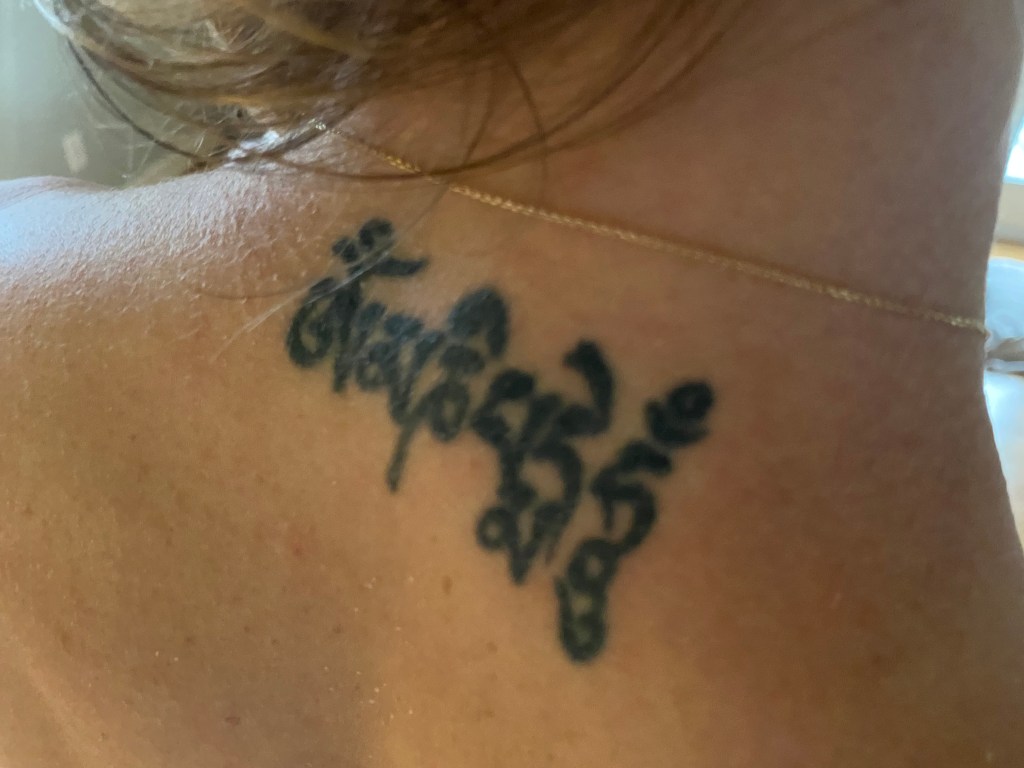
This picture is a photo of my first tattoo- a Buddhist manta “om mani padme hum”, most commonly translated to “Praise to the jewel in the lotus.” Further Tibetan spiritual teachings break down the mantra into its six parts, each part being a specific opposition to internal forces that cause suffering:
- Om (Ohm)- Om is the sound or “vibration” of the universe. This is the start to the mantra, and the most important sound. It is meant to destroy attachments to ego and establish generosity, the first barrier to suffering.
- Ma (mah)- Removes the attachment to jealousy and establishes ethics.
- Ni (nee)- Removes the attachment to desire and establishes patience.
- Pad (pad)- Removes the attachment to prejudice and establishes perseverance.
- Me (meh)- Removes the attachment to possessiveness and establishes concentration.
- Hum (hum)- Removes the attachment to hatred and establishes wisdom.
Those who practice meditation and Buddhism will often recite this mantra in a way to practice all 6 of the above perfections, from generosity to wisdom. It helps to develop love and compassion, in a world of suffering. When I got the tattoo over a decade ago, I think I got it more for the identity that it projects, rather than the meaning it encapsulates. But I’m fortunate in that the identity is one that’s stuck over the years, and the permanent imprint on my body has forced me to again and again consider the meaning.
Today, I consider it once again. As I look forward into 2021, I hope most of all to continue to learn. I hope to continue to grow. I hope to be the jewel in the lotus, to continue down the path of compassion and love, both for those around me, but also- and most importantly- for myself.
So, cheers, friends. Cheers to a new blog, may I write in this more than the last. May I write just to write, about everything and nothing at all. About spirituality, psychology, management and leadership, about travel and sport, about art and nature. May I write not for you (as much as I appreciate your time, dear reader), but for me.
Peace and love,
Emily
 The Jewel in the Lotus